
Facebook Privacy Settings Review

hackinjg_facebook

The hacking of e-mail accounts seems to be on the rise.  Just recently, the Bush family email accounts were hacked. Family photos of senior Bush,  phone numbers, and other images were among the personal items that were divulged. While the Secret Service is investigating the hacking of e-mail accounts belonging to the Bush family, we want to take notice of what our personal vulnerability could be, and do our best to protect information we do not want to share publicly with the Internet.

A recent New York Times, FaceBook article reviewed the importance of knowing how to protect your privacy – that is what ‘others’ see – you  post to your account.  Nowadays,marketers want to advertise to Facebook users. The new Facebook search tool provides that access.  For example, by default, search engines can link to your timeline. However, this function can be turned off. If you haven’t checked your account since December 2012, below is a summary of some things you may want to check soon.

♦ ♦ ♦ ♦ ♦ ♦

Check:

1)    Who can see my stuff

2)    Activity log ( posts, pictures) look at the original posts settings & likes.

3)    If you have  posts or photos in your timeline that concern you “unlike” or “delete ” it.

4)    Decide how much of your identity you would like to share, then go to your profile page, click “About Me” and decide what you want to be visible in your timeline, such as your birthdate.

5)    If you mind being tracked by advertisers, there are tools which can help you block trackers  (e.g Abine, Disconnect Me).

6)    If Facebook is showing you Ads you would rather not see, hover over the x and choose from the drop down menu – select hide this ad.

  • You can read more details at:

http://bits.blogs.nytimes.com/2013/02/07/new-stuff-ive-learned-since-my-facebook-privacy-tool-kit/

  • To find out more about Do not track software –click these links:

https://www.abine.com/

https://disconnect.me/tools

♦ ♦ ♦ ♦ ♦ ♦

I hope this is helpful.  See you at the next post 🙂

Dealing with Online Public Privacy

How many of us have given up on the online privacy issue? Just when you think you have it under control by using the tools your browser has made available to you, “they pull you right back in!” Some of you may already know that even if you use the preference signal requesting not to  be tracked via your browser choices, web sites can choose not to honor your request.

Recently an article by Natasha Singer of the New York Times discussed the various issues about the privacy of consumers using online services, and what is being done to address this concern.  In her article she advises that Microsoft’s latest version of its Internet Explorer browser coming out in October 2012, which is included with Windows 8, will have a “do not track” option. Below is a summary of that article.  Additionally, you can click the link to the article at the end of this summary to read all the details.

Some topics discussed in the article are:
  What is different about Microsoft’s new “do not track” option?   Answer: The new Internet Explorer 10 comes with the “don’t-track-me” option automatically enabled. Users will have to switch the option off on a customization menu to be tracked. Therefore, with this browser non-tracking is the norm.

This is a radical move for a technology company like Microsoft, which has an ad business of its own.  Here’s why: The prospect of people opting out of tracking presents a risk for marketers. Consumer data fuels the power of the Internet. Ads support “free” content like email services, search engines, as well as social networks.

 If millions of consumers “opt out” of behavior-based advertising many ad-sponsored sites could shut down or put up pay walls for people who choose not to see the ads.

Consumers generally do not change pre-set technology options, which heightens the concern of marketers that this browser could shift millions of people to the do-not-track category.

 The World Wide Web Consortium (W3C) an international standards body has created a working group to standardize the technology for do-not-track systems. However,  marketers and privacy advocates are still at odds over the definition of “do not track”.

 In the meanwhile, Twitter users will be interested to know that Twitter has already agreed to honor Mozilla’s do-not-track signal.

What’s certainly true is this discussion will continue to evolve, and as consumers of the Internet, it is a topic that we should continue to watch so that we know how information is being gathered about us.

To read more about this topic click the link below:

http://www.nytimes.com/2012/09/16/technology/in-microsofts-new-browser-the-privacy-light-is-already-on.html?pagewanted=all&_moc.semityn.www

I hope this is helpful 🙂

Find it …Keep it?

How many of us have experienced the loss of an unreturned phone?  Recently,  I was wondering what goes through any person’s mind who finds a phone belonging to someone else, and decides to keep it, or sell it.  What are their thoughts about keeping something that is clearly an important personal item of someone else?  Is it that they relate to the ancient Roman law, Finders, Keepers?

Finders, keepers is the adage with the premise that when something is unowned or abandoned, whoever finds it can claim it. This idiom relates to an ancient Roman law of similar meaning and has been expressed in various ways over the centuries..via Finders, keepers – Wikipedia, the free encyclopedia.

Have you ever had the opportunity to return something of value to someone else?  What makes a person do his/her best to return an item to the owner? Is it moral conviction/training value within a person?

Honesty refers to a facet of moral character and denotes positive, virtuous attributes such as integrity, truthfulness, and straightforwardness along with the absence of lying, cheating, or theft. “Honesty is the best policy.” — William Shakespeare, Mark Twain, Steve Landesberg and Tony Farrugia. all said this saying.via Honesty – Wikipedia, the free encyclopedia

The next time you find yourself in this situation, below are some guidelines and links to websites for details on what you can do if you believe that “honesty is the best policy”

If you find a locked iPhone

Since you can’t unlock the phone, you can’t poke around… But you do have options.

  • The first is to hold down the Home button for a few seconds, which may—depending on the owner’s phone settings—trigger either Siri or Voice Control. In either case, when prompted by the beep, say, “Call ICE.” If the phone’s owner has an ICE contact as described above, the phone will either start calling that person right away or ask you to clarify which number to call (as in, Home, Mobile, Work, etc). If you luck out and connect with the emergency contact, you can explain the situation to that person.via What to do if you find a lost iPhone | Macworld.

Call the police

  • You can also turn to your local police department. Manalapan, N.J., police officer Joe Felicia told Macworld that after you turn a found phone into the police, “if the owner responds to the police station and can identify the phone, the police department will return the phone to the owner. If not, the phone will go in a bin with hundreds of other phones.”

Felicia said that he sees “no problems” with trying to search the phone to locate the owner, if “it is being done in good faith.” The one catch: “If you are searching the phone and you stumble onto something that is obviously illegal… the phone would go directly to the police.”via What to do if you find a lost iPhone | Macworld.

Find the owner of a lost cell phone

  • Power the phone off. This can be done by holding down the power button on the phone. The power button is usually on the right side of the phone, toward the bottom. On some phones the power button is highlighted in red..
  • Turn the phone back on by pressing the power button again. You may need to hold the button for a second for it to power back on..
  • Watch the screen to discover the service provider. Once you know the service provider, contact the company’s customer support phone number. Many phone companies’ websites have “Contact Us” sections where you can find this number…
  • Answer questions from the representative the best you can. The agent may ask for the phone’s serial number and the type and style of the phone. If you are not sure of these answers, the support agent can help you locate information. The information you provide should be able to give the agent the information he needs to find the owner.
  • You may be asked to bring the phone to a local store or mail the phone back with a prepaid envelope the company sends you. via How to Locate Cell Phone Owners | eHow.com.

I hope this is helpful 🙂

Green Wi Fi in New York

Who doesn’t remember the mild-mannered avatar Clark Kent using the iconic telephone booths to change into Superman, and then flying off to ‘protect’ Metropolis !  Those were the good old days!

Well let’s Flash Forward to our Metropolis, New York City, where the telephone booth will now be used to enhance the lives of its citizens by providing Free Wi-Fi… Read on…

Let’s review what Wi-Fi is againWi-Fi internet is a way of accessing the internet using a wireless network through an wireless access point. This replaces the traditional use of using a networking cable to access the internet. Read More »via Ask.com – What’s Your Question?.

 New Yorkers and visitors are now able to connect free-of-charge using their smartphones, tablets, and other WiFi-enabled devices. Access is currently available at 10 locations, with additional hotspots to follow in the coming months.  via NYC Digital – News.

The wireless signal of the pay phone booths will span an 100 to 200 foot radius and the network will appear as “Free WiFi” or “NYC Free Public WiFi” on phones, laptops, tablets, and other WiFi devices.

 The network isn’t password protected, but when you launch your browser, you will be required to agree to terms and conditions before surfing the web. Read More via New York City Pay Phone Booths Now Free WiFi Hotspots – ABC News.

LOCATIONS:  Manhattan 402 West Broadway (at Spring Street); 458 Seventh Avenue (at 35th Street); 410 Madison Avenue (at 48th Street); 1609 Broadway (at 49th Street); 1790 Broadway (at 58th Street); 230 West 95th Street (at Broadway).Brooklyn 545 Albee Square; 2 Smith Street (both at the Fulton Street Mall).Queens 30-94 Steinway Street (at 31st Avenue). Read More via City Begins Wi-Fi Pilot Program in 10 Phone Booths – NYTimes.com.

Click for Maps:  via City of New York – NYC Public WiFi Hotspots – foursquare.

HOW TO USE PHONE BOOTH Wi-Fi

Look for a phone booth that says WiFi or Free WiFi labelled on it.

Stand within 200 feet of the WiFi-enabled phone booth.

On your phone or laptop, connect to either of the wireless networks, “Free WiFi” or “NYC Free Public WiFi.”

Upon launching your browser, agree to the terms and conditions.

Go on the Internet, email, stream, or do anything else Internet-related.

For more details click link: via NYC phone booths will be free WiFi Hotspots – How to connect to NYC WiFi phone booth? — New York Computer Help Blog.

I hope this is helpful 🙂

O/S–What Operating System?

How many of us are holding on to that computer we bought many years ago, hoping that it will serve our purposes in the future?  How many of us know what Operating System we are using, and, if we need an upgrade?

The Operating System is the most important program that runs on a computer.
Every general-purpose computer must have an operating system to run other programs.
 Operating systems perform basic tasks, such as recognizing input from the keyboard, sending output to the display screen, keeping track of files and directories on the disk, and controlling peripheral devices such as disk drives and printers. via Operating System – A Definition From the Webopedia Computer Dictionary.

¿ What Operating System Are You UsingWindows XP originally released in October of 2001. Almost 11 years ago.

  1. Today you may want to check which O/S you have on your computer.
  2.  Go to your Control Panel.
  3.  Click Help.
  4. Click About Windows.  A screen will pop up with the ‘version’ of your operating system.

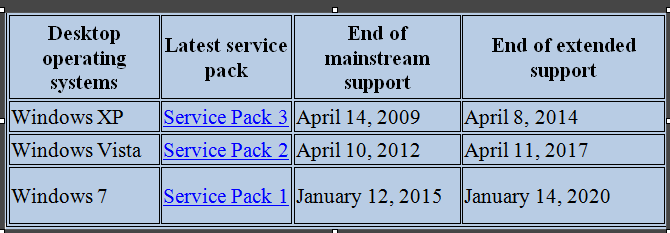
¿Is your Operating System Windows XP? If the answer is Yes, then you may want to consider an Upgrade because in the near future the XP Operating System will no longer be supported, and this will put  the information stored on your computer with an outdated XP O/S at risk.  Look at the chart below, and check  today if you need to upgrade.

Click the diagram to see a larger image

XP Operating System Users:
Below is an explanation of the things you should know. Click on the link for the fact sheet if you want a more detailed explanation.

SUPPORT

Extended support—(Commercial Customers Only) Microsoft will offer extended support for either a minimum of 5 years from the date of a product’s general availability, or for 2 years after the second successor product (two versions later) is released, whichever is longer.

End of Mainstream support …if you buy a new version of Windows and five years later another version is released, you will still have two years of support left for the previous version.

End of support refers to the date when Microsoft no longer provides automatic fixes, updates, or online technical assistance. This is the time to make sure you have the latest available service pack installed.

Without Microsoft support, you will no longer receive security updates that can help protect your PC from harmful viruses, spyware, and other malicious software that can steal your personal information. via Windows lifecycle fact sheet – Microsoft Windows.

Don’t delay, check your Operating System today!
In the next post we will talk about upgrading your Personal Computer.

I hope this is helpful 🙂

Tech News Overload….

It’s almost impossible to keep up with all the great and useful things to know that are happening on the technology front.  That’s why in upcoming Posts the format for tech4boomers will change to short burst of information with links to the web pages, or apps, or guidelines  etc., which will give you quick access to the things that interest you most. You will also want to visit DIGITWIRL, which has great suggestions and tips for organizing your technology world. A link to the website (Great Technology Tips) is available under BLOGS I LIKE.

The topics covered in this Post are : Health Apps, Healthful Computing, and How to Buy a Router.

HEALTH APPS

appear to be everywhere, and there seems to be one for everything.  I don’t know why I was surprised to read about these weight loss apps in a Nutrition Newsletter that I received in the ‘snail mail‘, but there they were prominently placed on a page all by themselves as the latest way to keep track of what you are eating by using an app on your smartphone, or computer.  Below are some of the APPS that were suggested, along with the links to them. I’ve read that free apps are just as good as any of the ones which charge a fee in this category.  Why don’t you check them out for yourself using the links below which goes with your device.

Name of APPMyFitnessPal – FREE

  • ANDROID USERS – Lose weight with MyFitnessPal, the fastest and easiest to use calorie counter for Android. With the largest food database of any Android calorie counter (over 1,700,000 foods), and amazingly fast food and exercise entry, we’ll help you take those extra pounds off! There is no better diet app – period.via Calorie Counter – MyFitnessPal – Android Apps on Google Play.

♣ ♣

Name of APPLose It! FREE

  • iPhone Users: Succeed at weight loss with Lose It! Set goals and establish a daily calorie budget that enables you to meet them. Stay on track each day by recording your food and exercise and staying within your budget. The average active Lose It! user has lost more than 12lbs and more than 85% of our active users have lost weight. Lose It! is completely free via App Store – Lose It!.
  • ANDROID USERS – https://play.google.com/store/apps/details?id=com.fitnow.loseit

♣ ♣

HEALTHFUL COMPUTING!

tech4boomers  has often written about the importance of being careful to protect your eyes when you are at the computer. Check out the tips at this site:
http://office-ergo.com/eyestrain-neck-pain/

♣ ♣

DO YOU NEED AN EQUIPMENT UPDATE?

When was the last time you updated your computer equipment?  I know many of us are trying to save those dollars, but it could be possible that by not evaluating whether your current computer equipment is serving your best interests both economically and aesthetically, and you could be paying more than you need to.  Take a look at the article, which appeared in PC World Magazine recently about Routers.  It will help you to check what steps you should take in deciding what is best for your technology purposes.

How to Buy a Router, By Armando Rodriguez, PCWorld May 3, 2012

Buying a router may not be at the top of everyone’s to-do list, but a new model can mean the difference between enjoying Netflix in HD and seeing a grainy mess of substandard video.

  •  Are you still using the router that your Internet service provider gave you? If so, you might not be getting the best results possible. Routers that ISPs provide tend to be older models running custom firmware, and the download and upload speeds from these routers may not match the speeds you pay for.via How to Buy a Router | PCWorld.

♣ ♣ ♣

See you at the next Post.  I hope this is helpful 🙂

FBI & DNS Changer: What’s it all about?

Glossary

DNS  – short for Domain Name System (or Service or Server), an Internet service that translates domain names into IP addresses. Because domain names are alphabetic, they’re easier to remember. The Internet however, is really based on IP addresses. Every time you use a domain name, therefore, a DNS service must translate the name into the corresponding IP address. For example, the domain name http://www.example.com might translate to 198.105.232.4. via  http://www.webopedia.com/TERM/D/DNS.html

Malware short for malicious software.  Malware is software designed to disrupt a computer’s operation, gather sensitive information, and/or gain unauthorized access to computer systems. via http://www.wikipedia.org/

Rogue DNS server – a rogue DNS server translates domain names of desirable websites (search engines, banks, brokers, etc.) into IP addresses of sites with unintended content, even malicious websites. Most users depend on DNS servers automatically assigned by their ISPs. via http://www.wikipedia.org/

SOHO Network – can stand for single office/home office network. via http://www.wikipedia.org/

ISP – an Internet Service Provider (ISP) is an organization that provides access to the Internet. The FBI has provided information to ISP’s that can be used to redirect their users from rogue DNS servers to the ISP’s own legitimate servers. DNS-changer-malware.pdf (application/pdf Object).

♦ ♦ ♦ ♦ ♦ ♦ ♦ ♦ ♦ ♦ ♦ ♦ ♦ ♦ ♦ ♦ ♦ ♦ ♦ ♦ ♦ ♦ ♦ ♦ ♦ ♦ ♦

Jared Newman, PCWorld,  has written a thorough article about DNS Changer. Below is a summary of that article, and what the FBI wants and warns users to do to be ready for what’s coming.

  • PC Users have until July 9, 2012 to remove DNS Changer Malware. After July 9, the FBI will ‘throw a switch’, which will prevent infected computers
    from accessing the Internet.
  • DNS Changer is a Trojan. Trojans conceal malicious software, and are not good for your computer.
  • DNS Changer redirects computers to hacker-created Websites. It also prevents computers from updating or using anti-virus software.
  • If users do not remove DNS Changer before the July 9 deadline, they ‘ll have to load anti-virus software by disk or USB drive.
    Users who do not have access to a second PC for downloading software will be at a disadvantage.

You can read the detailed article by clicking this link – http://www.pcworld.com/topics/security.html

♦ ♦ ♦ ♦ ♦ ♦ ♦ ♦ ♦ ♦ ♦ ♦ ♦ ♦ ♦ ♦ ♦ ♦ ♦ ♦ ♦ ♦ ♦ ♦ ♦ ♦ ♦ ♦

Guidelines for what you should do:

1) If this is all too complicated, hire a computer professional to help you.  🙂

2) Find out if you’re infected by visiting the DNS Changer Check-Up site by clicking this link – https://forms.fbi.gov/check-to-see-if-your-computer-is-using-rogue-DNS  (It checks the DNS resolution of your PC; however, it does not install more software).

3)  Infected users can check the DNS Changer Working Group for a list of anti-virus software to fix the problem. http://www.dcwg.org/

4) Avira offers a repair tool specifically for DNS Changer. To view Avira site click this link – https://www.avira.com/en/search?q=repair+tool&x=0&y=0

♦ ♦ ♦ ♦ ♦ ♦ ♦ ♦ ♦ ♦ ♦ ♦ ♦ ♦ ♦ ♦ ♦ ♦ ♦ ♦ ♦ ♦ ♦ ♦ ♦ ♦ ♦ ♦

Go directly to the FBI website for more details by clicking the link below

http://www.fbi.gov/

♦ ♦ ♦ ♦ ♦ ♦ ♦ ♦ ♦ ♦ ♦ ♦ ♦ See you at the next Post ♦ ♦ ♦ ♦ ♦ ♦ ♦ ♦ ♦ ♦ ♦ ♦ ♦ ♦ ♦

I hope this is helpful 🙂

Getting a Grip on AutoCorrect!

It’s downright embarrassing!  Causing my professionalism to be questioned!  Yes, you know what I’m talking about  #@%!AutoCorrect!

Someone is putting their words in my messages! Recently I sent a message discussing something I thought showed that I was comprehending the subject and in the middle of the sentence was the word ‘toot!   The list is long of those AutoCorrect/Autocomplete moments; however, it seems we can’t live with, or without it. Just in case you want to remove it or venture into finding out how to control it more to your liking, here are some tips that i found for Android, iPhone, and iPad users.

First, let’s review some of the selections for inputting information with the keyboards provided by your mobile devices.  For example, you may find Swype easier to input text on your mobile device. Here’s a brief description:  Swype   is an input method for touchscreens where the user enters words by sliding a finger or stylus from letter to letter, lifting only between words. It uses error-correcting algorithms and a language model to guess the intended word. It also includes a tapping predictive text system in the same interface. Swype is designed for use on touchscreen devices with a traditional QWERTY keyboard. via Swype – Wikipedia, the free encyclopedia.

According to Swype, it’s a faster way to input messages.  Maybe this will help you to control those AutoCorrect errors (?) Swype provides basic/advanced training guidelines, which you can get at this link: http://www.swype.com/

Android users can find a Tutorial for Swype  right on their mobile phones.  In addition, there is Swype Help with more details.

To find the tutorial  take the steps below:

  • Select Settings
  • Select Language & keyboard
  • Select Swype settings
  • Scroll down to find Help
  • Choose Tutorial

If you decide you want to stay with “Touch input” I suggest you take the Tutorial for how auto-correction works.

Use the steps below to find the tutorial

  • Select Settings’
  • Select Language & keyboard
  • Select Touch input
  • Select Tutorial

Touch input users may also want to consider adding their often used personal acronyms to their Personal dictionary, which is an option available right beneath the Tutorial. Choose the Edit personal dictionary, and add your words.

♦  ♦  ♦  ♦  ♦  ♦  ♦  ♦  ♦  ♦  ♦  ♦  ♦  ♦  ♦ ♦  ♦  ♦  ♦  ♦  ♦  ♦  ♦  ♦  ♦  ♦  ♦  ♦  ♦  ♦

iPhone users can check out Business Insider, which has some suggestions for “teaching” your phone new words among other ideas.  http://www.businessinsider.com/how-to-fix-iphone-auto-correct-2012-2#

iPad users can turn autocorrect off using the settings options.

I hope this is helpful.  See you at the next Post 🙂

The Facts Are In… From The FLA

The Fair Labor Association (FLA)  has completed, and made public, their report about labor conditions at Foxconn.  Below is a summary of what I found at their site. As always you can click on the link to read the full disclosure at  the FLA website.

FLA’s investigation found that within the last 12 months, all three factories exceeded both the FLA Code standard of 60 hours per week (regular plus overtime) and the Chinese legal limits of 40 hours per week and 36 hours maximum overtime per month.

During peak production periods, the average number of hours worked per week exceeded 60 hours per worker.

There were periods in which some employees worked more than seven days in a row without the required 24 hours off.

Full worker survey data is available at http://www.fairlabor.org/affiliate/apple.via Fair Labor Association Secures Commitment to Limit Workers’ Hours, Protect Pay at Apple’s Largest Supplier | Fair Labor Association.

I was wondering how many people still  felt that Mike Daisey’s way of  getting this information out still should be judged so harshly.  Before he presented this information in his show,  I don’t believe many of Apple’s customers (myself included) knew much about  how the Apple products are made in China.  Here is an excerpt of an article by Mark Radcliffe that I found  in my readings about Mike Daisey I would like to share with you. As always click the link to read the entire article.

♦  ♦  ♦  ♦  ♦  ♦  ♦  ♦  ♦

Mark Radcliffe notes that discoveries of more violations at Apple’s Foxconn manufacturing plant in China prove that Mike Daisey wasn’t as wrong as once thought…

I wrote about this controversy last week, so I’ll try not to repeat too much of my argument. But my point is that the level of condemnation employed by most journalists against Daisey strikes me as misplaced. I find it troubling that there was such a frenzy to tear him down, when at the end of the day, it was still his show (and the general truth behind it) that is largely responsible for shining the light of scrutiny on the labor practices of the world’s richest company. There was an OCD-esque desire to throw out the baby with the bathwater as soon as a few smaller details were in contention.

But almost no one simply acknowledged that he did go to China. He did visit factories. He did talk to workers, all in an effort to know the truth. The headlines imply he made it all up while sitting on his couch at home. We should have two different levels of scorn for someone who lies about everything sheerly for fame, and someone who merely stretches the truth to help raise awareness about a labor rights issues. via Mike Daisey’s Lies Appear To Be Mostly True @MarkRadcliffe — The Good Men Project.

It’s certainly worth thinking about what Mark Radcliffe has to say on this topic.  I would also like to share a quote with you that I found before I close this Post>

Life’s most persistent and urgent question is, ‘What are you doing for others?’” Martin Luther King, Jr. quote