Unknown's avatar

About autocreate740

I am a senior citizen retired after working for 50 years in various professions. I find social media intriguing, blogging uplifting, and technology in general a welcomed challenge. My newest interests are Aromatherapy and Essential Oils. I have recently acquired an Aromatherapist Certification from the New York Institute of Aromatics. I write about all of these interests as topics on my various blogs. I am hopeful that the posts I create bring information that is useful and moves my readers to explore more.

Wi Fi, 3G, 4G, Data Plans ? So many decisions! What’s a person to think?

It’s all so complicated! 

How does one make decisions about using cell phones; what service should you sign up for? Why do you need a data plan anyway?

AT&T pointed out recently, 200MB of data gives you the capability to send and receive 1000 e-mail messages no attachments and 150 e-mails with attachments, view 400 Web pages, post 50 photos on social media sites, and watch 20 minutes of streaming video.

via AT&T’s New iPhone Data Plans: Pros and Cons | PCWorld.

I cyber-searched’ for answers to these questions. Hopefully, my excerpts will assist you in understanding what you require and how to make decisions about your cell phones and data plans. Also, there will be links to the websites where I found information so that you can research more thoroughly, should you want to do so.

                                               ***********

What is WiFi?  Wi Fi is short for Wireless Fidelity and..?     🙂
According to Dictionary.com, wifi:wireless local area network: a local area network that uses high frequency radio signals to transmit and receive data over distances of a few hundred feet.

What is 3G? 3G is an umbrella term for a collection of technologies that make up the third generation of cellular data networks. These standards allow cell phones (and other devices capable of connecting to a cellular network) to send and receive data at speeds comparable to cable or DSL. via In A Nutshell: What Is 3G?.

What is 4G? 4G, an acronym for fourth-generation wireless, is a technology that will transform wireless communications in a completely new way. It is also known as “beyond 3G,” since it provides a comprehensive and secure IP (Internet Protocol) solution. Users will enjoy high quality streaming video and “anytime, anywhere” voice and data at a much higher speed than previous generations. via What is 4G?.

Other things you should know:

Notes:

* While some Internet Service Providers offer both 3G and WiFi internet, they usually consider them separate services and require separate subscriptions.

* 3G is almost always more expensive than WiFi connected to a fixed service, so when WiFi is available – use it!

* Most 3G Service Providers offer a USB modem with their subscription services at a cost.

* 3G can be quite fast, but is in most cases worse than WiFi.

* Other wireless technologies also exist.

via Cryptech V2 » Blog Archive » The Difference Between 3G Mobile Internet and WiFi Wireless Networks.

  Do you need a data plan?

The first thing you have to do is to guesstimate how much data you think you’ll use. Two gigabytes of data per month seems to be the magic cut-off for most carriers. The vast majority of customers–98 percent, according to AT&T–use less than this each month. Average smartphone subscribers are using roughly, 400 MB of data per month, according to Validas, which recently analyzed a year of consumer phone bills from all four major carriers.

A couple of carriers, AT&T and T-Mobile, offer 200MB plans for low-data consumption. The lowest tier of service that Verizon Wireless offers is 2GB. And Sprint only offers an unlimited data plan for its smartphone customers.

But as you can see these plans aren’t tailored precisely for average usage. So most smartphone subscribers will need more than the 200MB plan but less than 2GB.

via Ask Maggie: Help! These data plans are too confusing | Signal Strength – CNET News.

All the major carriers offer tools on their Websites to help you estimate your usage. So I suggest checking that out to get a sense of what you think your usage will be. Here’s a little guide put together by Verizon Wireless that should give you an idea of how much data certain activities eat up:

* Email (text only) = 10KB

* Typical Web Page Lookup* = 1.5MB

* Audio Streaming = 40MB/hr

* Lo-Res Video Streaming = 200MB/hr

* Hi-Res Video Streaming = 400MB/hr

* Digital Photo download/upload (Hi-Res) = 1MB

$$$$$$  What will it Cost?
 The next thing to consider is price. T-Mobile’s 200MB tier is $10 a month. The good thing about its service is that if you go over your limit, it only slows your service. This means you aren’t socked with additional overage fees. AT&T’s 200MB service is $15 a month. But if you exceed this limit, your service isn’t slowed or “throttled.” Instead, you’re charged more money for more usage.

via Ask Maggie: Help! These data plans are too confusing | Signal Strength – CNET News.

🙂   That’s all for now folks.   I hope this is helpful!

Intro to Twitter_Tech4Boomers_Session 4

Who’s your Twitter in-crowd?

On Twitter, it’s all about who and what you Follow.  Following is a huge part of what’s happening in this particular social universe.

‘Following’ is a personal choice.  A good place to start is with  ‘friends’ whom you already know, in your personal ‘social circle’, those who are also Tweeps.  In this way, they can guide you on how to send Tweets, and give you a sense of belonging to the Twitter community until you get comfortable with tweeting in a larger social network.  Ask your friends what their Twitter ID’s are.  Once you have the ID’s, you can search for them using the SEARCH field.  When you find an ID, click the Follow link.

                                    **********

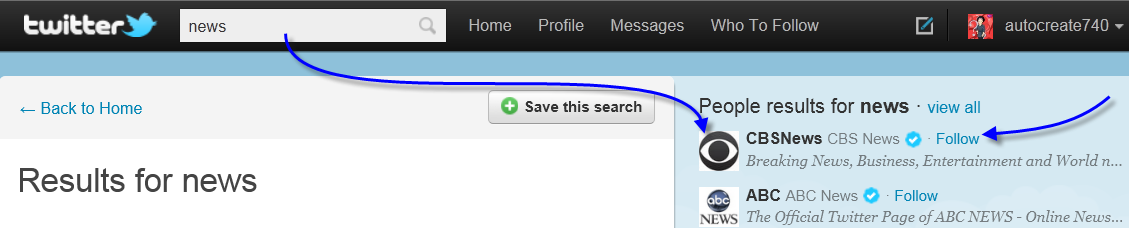
Another way to get started with Following on Twitter is to find people or publications that interest you.  When you find them, just click on the Follow button as illustrated below:

1 – In the SEARCH field, I have entered the word News.  On the right of the panel various news options appear with the word Follow next to them.

Click on the images to see a larger version.

2 – After you click on the Follow link.  Click the Back Home link to see your Timeline.

3 – When you are back at the Home screen, the News has been added to your Timeline along with everything else (Tweeps) you are following.

4 – If you do not want to Follow a particular choice (e.g., News)  anymore, type News in the search field, click the magnifying glass to start the search.  When you find what you are looking for,  click the Unfollow link.  You can also go to your Profile, view all you are following, and select to Unfollow from there.

Following is entertaining, informative,  and fun when you become part of the Twitter social network.  There is much to learn, and be a part of in this  social environment.   I hope you will join us soon 🙂

This completes our Beginner, Tech4Boomer Twitter sessions. See you next week.  🙂

To Be a Tweep or Not

‘To be a Tweep” or not’. There’s no question that Twitter and sending ‘Tweets‘ to your ‘Tweeps‘ is the latest social gadget we have found to entertain ourselves while doing business’. Is this the new ‘game of life?’. I wonder… On the horizon is Microsoft’s new Avatar application. We can replace our ‘real faces’ with an Avatar which looks just like us! Go figure?.. Does that mean Facebook pics will need to be replaced with Avatar pics ? Where where will the real us reside in the end?

Intro to Twitter_Tech4Boomers_Session 3

Avatars >>>Who are you?

Which one are you?

Is an Avatar important to have on Twitter?  Well, that  depends on your personal preference.  For example, some of us do not  believe that we are photogenic, and would rather not place a picture of ourselves on the Internet. For those of you who are still pondering how to deal with this issue, you may want to consider why an Avatar of your choice might be preferable, as opposed to having the generic one that Twitter assigns.  I mean, an EGGFor real?

Here is what Wikipedia (my favorite source for definitions) has to say about Avatars for computing:

Avatar (computing) In computing, an avatar is the graphical representation of the user or the user’s alter ego or character. It may take either a three-dimensional form, as in games or virtual worlds, or a two-dimensional form as an icon in Internet forums and other online  communities… It is an object representing the user. The term “avatar” can also refer to the personality connected with the screen name, or handle, of an Internet user.

So for those of you who would rather not appear on Twitter as an EGG, think about a picture, or some representation (a flower), something that you’d rather see yourself represented as on Twitter, then use the guidelines below to create your unique Avatar.  Here we go.

Once you have found a picture that you want to use for your Avatar, and save it in a format that you can ‘upload’ (e.g. png, peg extensions), it takes several steps to complete the upload of your Avatar to your Profile.  I have created six (6) diagrams to assist you with completing this task.  To see the diagrams clearly, just click with your mouse on the image provided.  You can also send them to print using your Browser.

Diagram 1 = Save your picture in a format you can upload on your Desktop.  Sign onto Twitter.  Click the Profile tab.

Diagram 1

Diagram 2 = Look for the picture you saved on your Desktop. Select (highlight) it. Click the Open button.

Diagram 2

Diagram 3 = When the file (name) you selected appears next to Browse, click the Save button.

Diagram 3

Diagram 4 = Twitter will begin to upload the file and the image below will appear.

Diagram 4

Diagram 5 = When the upload is complete your Avatar picture will appear in the picture box.

Diagram 5

Diagram 6 = You have just completed the upload of your Avatar.  Click the Home button to return to the screen where you started 🙂

Diagram 6

Note:

Sometimes it takes a little while for your Avatar to show up on Twitter. Be patient, you will see yourself with a new image shortly.

Now you are dressed for the party 🙂 ! See you on Twitter !

Intro to Twitter_Tech4Boomers_Session 2

Now that you have your Twitter ID, and are able to log in, you will want to become acquainted with how to send Tweets.  “Tweets” are the messages you type.  You can type a maximum of 140 characters.  Don’t worry,  Twitter counts the characters for you!  🙂

There are  Help/ guidelines available  in Twitter, which you can access with the down arrow next to your user name as shown in the illustration below.

Get help here

Use the Help button for detailed guidelines


You are now ready to send ‘Tweets‘.  Begin by getting acquainted with the “navigation tabs”,  illustrated below.
Click the image to see a full screen.

Tweet Buttons

I expect that you will become increasingly capable in deciding whom you want to “Follow” .  In the 3rd session of Intro to Twitter_Tech4Boomers, we will cover Avatars, and how to create one.  In the 4th session of Intro to Twitter_Tech4Boomers we will review how to “Follow” other “Tweeps” on  Twitter.

Stay tuned 🙂

Intro to Twitter_Tech4Boomers_Session 1

I have heard from Boomer friends, and family that they have a Twitter account, but have not used it.  Some have said that they just can’t figure out what to do with all the little Icons provided on the screen. Well, in order to assist those who want to join, and those who have already joined, but are not using it, the guidelines in this post are designed to get you started.  In addition, Twitter has a wonderful support system, which is very easy to understand, and easily accessible.

  1. Navigating in Twitter requires that you have an email account.  Make sure you know what password you want to use before you sign-up.

  2. Twitter works via text, therefore the cost of using Twitter is usually what you pay for text messages on your phone.  Check with your carrier before you sign-up, so that you are clear about cost.

Note: Twitter has a 140 character limitation for each Tweet.  Who knows, maybe it’s just what you need to cut down on your bill 🙂 !

  1. You can choose to use your email as your user name; however, many people use their first name as their username so they can be recognized by their friends, and others.

  2. When your account has been created it will have an @symbol placed in front of it, for example, judith would become @judith

Note: Sometimes a number is added to your user name to avoid duplication. You can change your user name at a later date without affecting existing Tweets.

You can create an account at https://Twitter.com,  to fill out a form like the one below, then click the Sign Up button.

The next set of guidelines will show the Twitter Navigation Toolbar from a Personal Computer screen view.
NoteClick the image to see clearly.

See you at the next session.  🙂

NO PHISHING PLEASE!

  Nowadays it’s smart to  think cautiously BEFORE you open any emails from sources whom you do not recognize.  Why??  PHISHING !  Below is a description I found in Wikipedia.

Phishing is a way of attempting to acquire sensitive information such as usernames, passwords and credit card details by masquerading as a trustworthy entity in an electronic communication. Communications purporting to be from popular social web sites, auction sites, online payment processors or IT administrators are commonly used to lure the unsuspecting public. Phishing is typically carried out by e-mail spoofing or instant messaging,

[1] It often directs users to enter details at a fake website whose look and feel are almost identical to the legitimate one. Phishing is an example of social engineering techniques used to deceive users.

[2] Exploits the poor usability of current web security technologies.

[3] Attempts to deal with the growing number of reported phishing incidents include legislation, user training, public awareness, and technical security measures.

Take a look at the guidelines provided  by APWG  in order to learn how to protect yourself from this type of Internet crime.

Anti-Phishing Working Group
The Anti-Phishing Working Group (APWG) is the global pan-industrial and law enforcement association focused on eliminating the fraud and identity theft that result from phishing,pharming and email spoofing of all types.

http://www.antiphishing.org/consumer_recs.html

Be careful folks!

Cyberspace Email Manners

If you had to give yourself a grade, what would your mark be for your Cyberspace Email Manners?  Take a look at the chart below and give yourself a grade.  If you’re interested in how you did and want to know more about what are considered acceptable manners on the Internet, check out the articles  I came across from the on-line  Pink Magazine.

Take a moment to read what the experts say 🙂


Yes You Can Backup Your WordPress Blog!

I am sure we have all been there, trying to get out that extraordinary post – you know-  the one that really gets your message out to your followers, and then “uh oh”, your computer,  or your software, or whatever!  Something happens to your Blog!

We’ve all been there at least once.  And, we usually don’t think about backup until that fatal moment when we cannot recover the wonderful piece of genius that we just wrote.  🙂

Well, I am here to tell you, Yes you can backup your WordPress Blog !  with the help of Christopher S. Penn he makes us all protectors of our Blogs!

Check out his guidelines at: http://www.christopherspenn.com/2009/05/how-to-back-up-your-wordpress-blog-in-60-seconds/#disqus_thread

Should Boomers be LinkedIn?

What is LinkedIn used for ?

LinkedIn is a professional social networking site. It’s something like a professional rolodex, which is maintained on the Internet.

  1. To be successful with LinkedIn, it is recommended that you establish your ‘connections with professionals you already know.

  2. If you’re a Boomer entrepreneur, or Boomer just looking for work, it would appear that this is an awesome resource you should tap into.


Below are some guidelines on how to join LinkedIn with integrity.

What is Required?

  1. New Linkedin members should be prepared to include a picture of themselves.  Preferably the picture should be of your face without any designs in the background.
  2.  Make sure your summary is well written, to the point, appealing. so that it makes people want to know more about you.
  3. When you fill in your Bio, as with the ‘older’ style resumes (not so long ago), make sure it is the truth folks.
  4. Send invitations for ‘connections’ to professionals with whom you have a prior business relationship.
  5. Be aware when you send an invitation, you can receive an ‘I don’t know’ (IDK) response from the recipient which counts against you.
  6. Five IDK’s will result in your having to submit your email address every time you try to make a ‘connection’.
  7. Make your profile ‘public’ if you want to reach the full potential of the network.

After you establish your list, below are some perks of being ‘connected’ with LinkedIn, which are covered in Wikipedia:

  1. It can be used to find jobs, people and business opportunities recommended by someone in one’s contact network.
  2. Employers can list jobs and search for potential candidates.
  3. Job seekers can review the profile of hiring managers and discover which of their existing contacts can introduce them.
  4. Users can post their own photos and view photos of others to aid in identification.
  5. Users can now follow different companies and can get notification about the new joining and offers available.
  6. Users can save (i.e., bookmark) jobs, which they would like to apply for.

Guidelines for joining can be found at:

1.     http://learn.linkedin.com/settings/

2.     http://windmillnetworking.com/2009/05/27/linkedin-group-etiquette-what-are-the-rules/

Join at https://www.linkedin.com/reg/join


Below is a great resource for Older Workers (just click the link) 🙂

 http://hubpages.com/tag/older+workers/hot